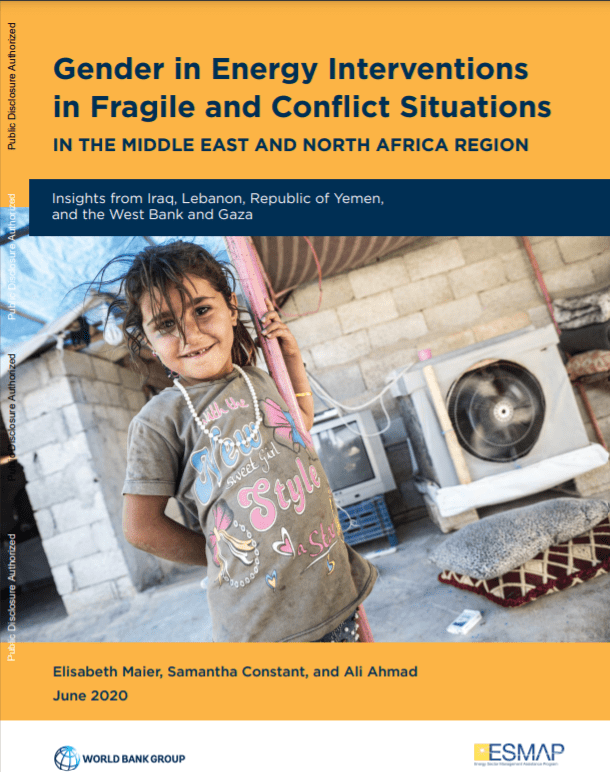
Gender in Energy Interventions in Fragile and Conflict Situations in the Middle East and North Africa Region
The Middle East and North Africa (MENA) is home to some of the most fragile situations and conflict-affected population in the world. With one in five people in the region living near conflict, nearly half of the economies of the MENA region are classified as fragile and conflict situations (FCSs).
In such challenging contexts, the provision of basic and essential services, such as electricity, becomes a priority to mitigate the heavy burden of conflict and instability, particularly on the most vulnerable women and men, who are affected in different ways. The objective of this report is to advance the understanding of the gender-energy-fragility nexus, with a focus on some of MENA’s fragile and conflict situations, namely, Iraq, Lebanon, Republic of Yemen, and the West Bank and Gaza.
The research and data cover (i) an overview (and typology) of the gender, energy, and fragility landscapes in the studied countries, (ii) related evidence and analytics drawn from the World Bank’s energy interventions and operations in the MENA region, and (iii) distilled policy recommendations tailored to the contexts of the examined countries.
Gender Indicators for Sustainable Energy: A Call to Action 2026 UPDATE
This document is part of a series of policy briefs compiled by the multistakeholder SDG7 Technical Advisory Group (SDG7 TAG) in support of the review of SDG7 at the High-level[…]
Renewable energy: A gender perspective (Second edition)
This second edition of the report, Renewable energy: A gender perspective, updates global figures and offers policy recommendations to strengthen gender equality across the energy transition.