The clean energy transition cannot scale fast enough without the women who power it as decision-makers, project managers, engineers, entrepreneurs, and advocates. As the transition accelerates to close the energy access gap in Africa, building inclusive leadership pipelines and governance is required to support project implementation and success. Women’s leadership is a force multiplier for the energy transition.
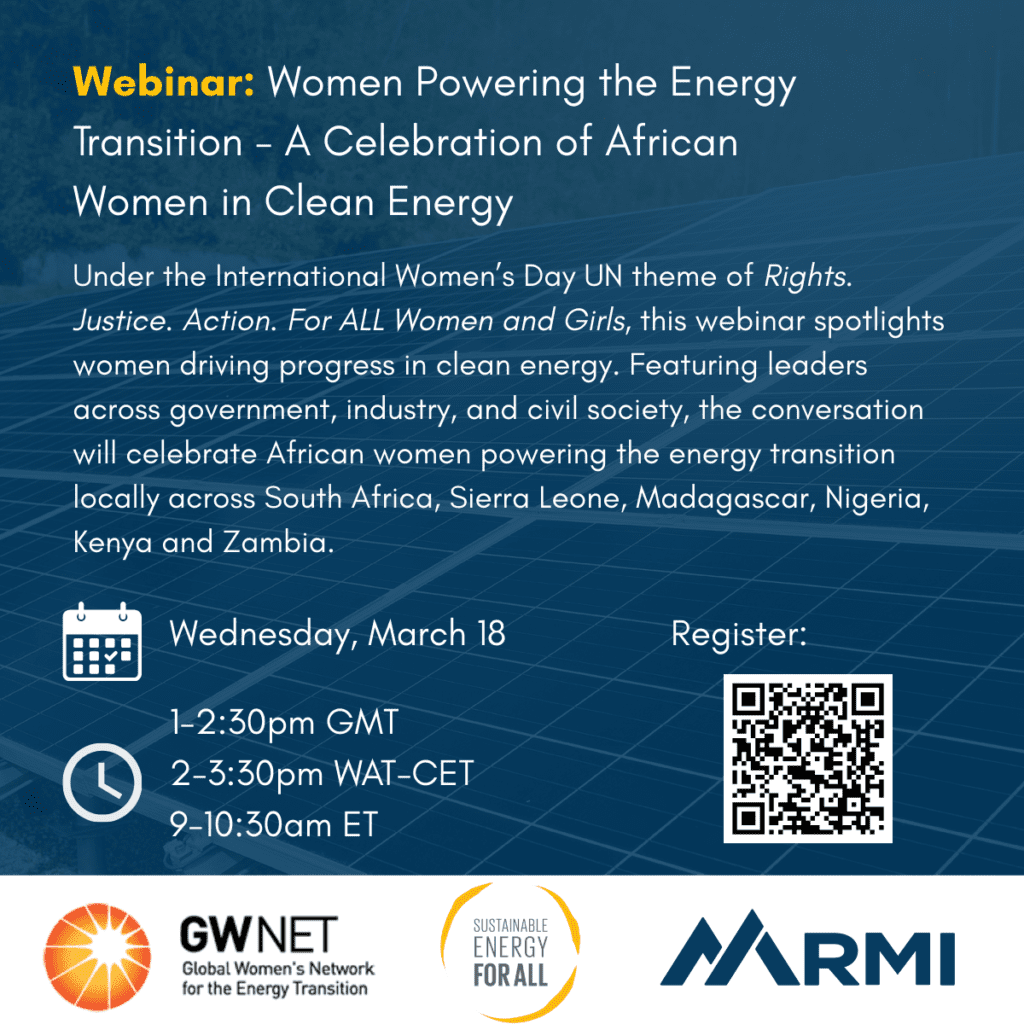
On March 18th, GWNET, Sustainable Energy for All (SEforALL) and The Energy Transition Academy (ETA) at RMI will come together in celebration of International Women’s Day under the UN theme, “Rights. Justice. Action. For ALL Women and Girls.” We will spotlight women who are catalyzing project implementation and delivering results across the clean energy sector. From South Africa to Madagascar, Zambia, Nigeria, Sierra Leone, and Kenya, our speakers and alumnae are not waiting for change, they are building it.
About The Energy Transition Academy (ETA) at RMI
The Energy Transition Academy (ETA) at RMI empowers women leaders, strengthens their networks, and supports them in advancing clean energy projects and inclusive organizational practices. In doing so, the ETA contributes to a faster, more equitable, and inclusive energy transition.
About SEforAll
Sustainable Energy for All (SEforALL) is committed to empowering young women to participate fully in the energy transition by creating education and training opportunities that will prepare them for careers within the renewable energy sector. Projects involving local deployment of renewable energy solutions, energy planning or other forms of technical assistance provide valuable learning opportunities.
is aimed at training young women to prepare them for careers in the sustainable energy sector. The programmes are tailored towards ongoing in-country workstreams, allowing practical application of skills and knowledge to the context of energy transition in the target countries. It provides trainees with a robust learning experience by teaching both technical and soft skills linked to direct employment. By 2025, 46 women have been supported through the traineeship programme across Colombia, Ecuador, Ghana, Honduras, Kenya, Mexico, Panama, Tanzania, and Sierra Leone.